
Listen to this article
ReadyWant more voice choices? Your available voices come from your device or browser. Additional text-to-speech voices may be available in your device’s speech or accessibility settings.
We tend to think of peace as something that happens when everything settles down. When the problem is solved. When the conversation is over. When everyone behaves. When the noise stops.
The problem is, life doesn't always settle down.
Something happens. Someone says something. Plans change. A problem shows up that wasn't there five minutes ago. And almost immediately, we react. We decide what it means. We decide why it happened. We decide what somebody meant by it.
Sometimes we are halfway through an argument in our own head before we have even figured out what actually happened.
What if we didn't?
What if the first thing we did was simply observe? Not fix it. Not explain it. Not decide who is right.
Just look.
Then pause.
That little bit of space can change everything.
Observe. Pause.
Neither one requires the situation to change. Neither one requires another person to change. And neither one requires us to know what we're going to do next.
That comes later.
For now, we are simply making room to see what is actually there. And maybe that is where peace begins.
Not when everything becomes peaceful.
When we stop requiring it to be.
One of the most useful things I have learned is that I can observe my own thoughts. That sounds almost too simple to matter.
It isn't.
A thought can arrive and I can notice it without immediately responding to it. I can hear the argument starting in my head. I can notice myself filling in the blanks. I can recognize when I am going over the same thing for the tenth time.
That moment of noticing changes something.
Now there is the thought, and there is also the part of me observing the thought.
I have become the witness.
That little bit of distance gives me a choice I didn't have when I was simply reacting.
I don't always do it. Sometimes the reaction gets there first. But every experience gives me another opportunity to practice. I notice sooner. I pause a little longer. I become more curious about what I am thinking and less compelled to immediately do something about it.
Being the witness doesn't make the thought disappear. It simply means the thought doesn't automatically get to decide what happens next.
And that can keep me out of a place I have visited more times than I care to admit.
The House of Assumptions.
Oh, you can get lost in that place.
It usually starts innocently enough. Something happens and I don't have all the information, so my mind fills in the missing pieces.
I decide what someone meant. I imagine why something happened. I predict what will happen next. Then I begin responding to those assumptions as though they are facts.
One assumption leads to another, and before long I have furnished the place.
I've done that. Been there. Sometimes many times.
The witness helps me find the door.
What do I actually know?
Not what do I suspect. Not what seems likely. Not what story have I built around it.
What do I know?
Sometimes the answer is surprisingly little.
That doesn't make my concerns wrong. It simply separates what I observed from what I added afterward. Once I can see the difference, I have choices again.
Of course, the House of Assumptions has another resident.
The Plate Spinner.
Sometimes I enter carrying one problem. It doesn't stay one problem for long.
One thing actually happened. That's the first plate.
Then I wonder what someone meant by it. Another plate starts spinning. I wonder what caused it. There's another. Then I imagine what might happen tomorrow because of it.
Another plate.
Before long, I am trying to manage five or six problems when only one of them may actually exist.
And the House of Assumptions has storage.
Sometimes those extra plates don't come from imagining the future. We bring them in from the past.
Something happens today and suddenly we remember something someone said years ago. Then another experience gets added. And another.
Maybe something Grandma said in 1999 has somehow found its way onto a plate.
Those experiences may be real. They may even matter.
But they are not necessarily this experience.
Being the witness lets me stop and look at all those spinning plates.
Which one contains something I actually observed? Which ones are possibilities? Which ones are assumptions? Which ones did I pull out of storage?
Maybe there really is a pattern worth noticing. Discernment doesn't ask us to ignore that. It asks us to look before deciding.
Sometimes there really are several plates.
Sometimes there is only one.
The important thing is knowing which is which.
And occasionally, after putting down all the plates that don't belong, I look at the one remaining plate and think:
Wait. What was this all about?
Sometimes the original issue is surprisingly small once everything we added to it has been removed.
This is where discernment enters.
Once we have paused, we have room to look again.
What do I actually know? What am I assuming? Does this belong to me?
Not everything that reaches us requires us to pick it up.
Someone else's mood may not belong to us. Someone else's opinion may not require our defense. A problem may be real without being ours to solve.
And sometimes it does belong to us.
Something needs attention. A boundary needs to be drawn. A mistake needs to be corrected. A difficult conversation needs to happen.
Peace doesn't mean avoiding those things. It means seeing them clearly enough to decide what they actually require.
That is different from reacting.
The pause gave us space. Discernment helps us decide what deserves to enter that space.
And only then are we ready to choose.
Eventually, we choose. Not because we have figured out everything. Not because we can predict what will happen next.
We choose because, after observing, pausing, and discerning, we know enough to decide what we want to do with what is in front of us.
Sometimes the choice is to speak. Sometimes it is to walk away. Sometimes it is to wait. Sometimes it is to say no. Sometimes it is to say yes.
And sometimes the choice is to do absolutely nothing.
Doing nothing is not always avoidance. Silence is not always weakness. Waiting is not always indecision.
They can be deliberate choices.
So can action.
The important difference is that we are no longer simply reacting to the first feeling, assumption, or interpretation that arrived.
We are choosing.
Of course, choices have consequences.
We may make a thoughtful choice and still not like what happens next. Someone may misunderstand us. The problem may remain. We may even discover that we chose poorly.
That doesn't mean the process failed.
A consequence is not the end of our choices.
We can observe again. Pause again. Discern again. Choose again.
There are also times when the problem has been observed. We have paused. We have thought about it. We have decided whether there is something that needs to be done.
And there is nothing more useful to do with it right now.
But the mind doesn't always get the message.
It goes back. Replays the conversation. Reconsiders the possibilities. Tries another explanation. Then circles around and does it all again.
At some point, continuing to think about something isn't helping us understand it better.
We're just walking the same path.
That is when I sometimes choose to create.
I write. I take photographs. I work on an idea. I make something that wasn't there before.
It isn't pretending the problem doesn't exist. It isn't running away from it.
I have already observed it. I have given it my attention. I have discerned whether there is something I need to do.
Now I am choosing where my attention goes next.
That interruption matters.
The mind that was looping has something new to explore. Curiosity returns. Sometimes humor does too.
And sometimes something unexpected happens.
One idea leads to another. We begin asking what if? instead of replaying what happened?
That has happened to me more than once.
A website that began as a practical collection of information somehow ended up with houses, doors, drawers, wagons, and eventually an entire Rabbit Hole.
None of those things existed until attention moved somewhere new.
The original problem didn't have to disappear first.
I simply stopped giving it all the available space.
And in that space, something new grew.
The thought wasn't erased. I simply stopped letting it choose what happened next.
I don't always get there before the knee-jerk reaction. Sometimes I recognize it while it's happening. Sometimes afterward.
There will apparently be plenty of opportunities to practice.
I can observe again. I can pause again. I can ask what is real, what I have assumed, and which plates actually belong to this moment.
Then I can choose again.
Maybe that is why peace isn't something we achieve once and then protect from the rest of the world.
It is something we return to.
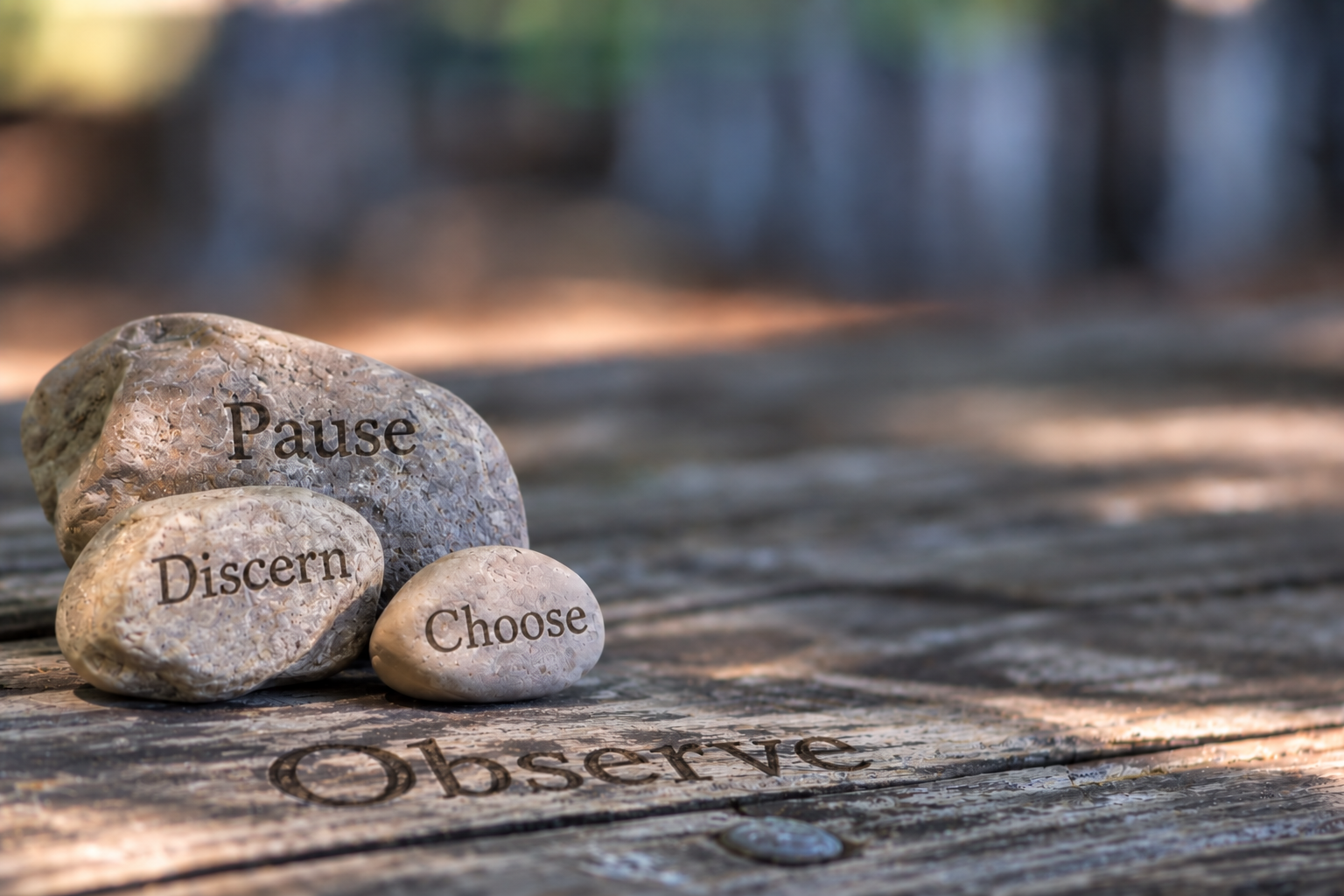
Observe. Pause. Discern. Choose.
Again and again.
Peace isn't the absence of disturbance.
It isn't everything finally going our way.
It isn't a quiet world with nothing left to challenge us.
Peace is what we do when the world around us isn't peaceful.
We observe.
We pause.
We discern.
We choose.
And when necessary, we choose again.
Peace is a verb.